
Telehealth
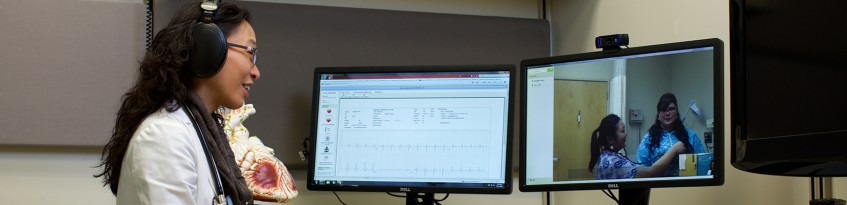
ANTHC’s telehealth services allow health care professionals to work together in the Tribal health system to provide quality care and increased access for Alaska Native people across the state.
The Telehealth Department provides the following:
- Clinical support services including real time support for questions and/or problems related to patient care delivery via telehealth
- Some onsite support to the ANMC campus
- Pre-visit testing and education services for patients and/or families receiving direct to home video visits
- Support and training for clinics and ATHS partners wishing to develop new/expand existing clinical service lines.
- The Statewide Systems Support Team serves as tier 2 support for our tribal health partners.
- They also offer telehealth hardware solutions and recommendations.
Telehealth department is involved with ANMC Project ECHO, an educational and guided practice program designed to help empower rural clinicians.
History
AFHCAN, a program of the Alaska Native Tribal Health Consortium (ANTHC), has developed cutting edge telehealth solutions since 2001. AFHCAN designed and developed an innovative store-and-forward telehealth solution to meet the health care needs of rural Alaska. AFHCAN has evolved into an FDA listed medical device manufacturer that provides an array of telehealth products and services that empower organizations to improve health care delivery worldwide. In working with multiple independent health care organizations for nearly two decades, AFHCAN has developed an evolving line of supported telehealth services. Our program development staff collaborates with individuals and organizations to establish successful telehealth programs that fit within existing clinical workflows
AFHCAN continues to develop new solutions to accommodate the rapidly expanding demand for telehealth across the Alaska Tribal Health System.
Publications
Successful Implementation of a Telemedicine-Based Counseling Program for High-Risk Patients with Breast Cancer – 2013
Telethinking with A. Stewart Ferguson, Ph. D – 2012
The Impact of Telehealth on Wait Time for ENT Specialty Care – 2010
Preoperative Planning for Ear Surgery Using Store-and-Forward Telemedicine – 2010
Selecting the Right Digital Camera for Telemedicine- Choice for 2009- 2010
Traveling an Audiologist to Provide Otolaryngology Care Using Store-and-Forward Telemedicine – 2009
Selecting a Digital Camera for Telemedicine – 2009
Digital Images for Postsurgical Follow-Up of Tympanostomy Tube in Rome Alaska- 2008
Which Tympanometer is Optimal for an Outpatient Primary Care Setting -2006
Rural Telemedicine: Lessons from Alaska for Developing Regions- 2005
Alaska Telemedicine: Growth Through Collaboration – 2004
A Comparison of In-Person Examination & Video Otoscope Imaging for Tympanostomy Tube Follow-Up- 2003
ECG Acquisition Using Telemedicine in Alaska -2003